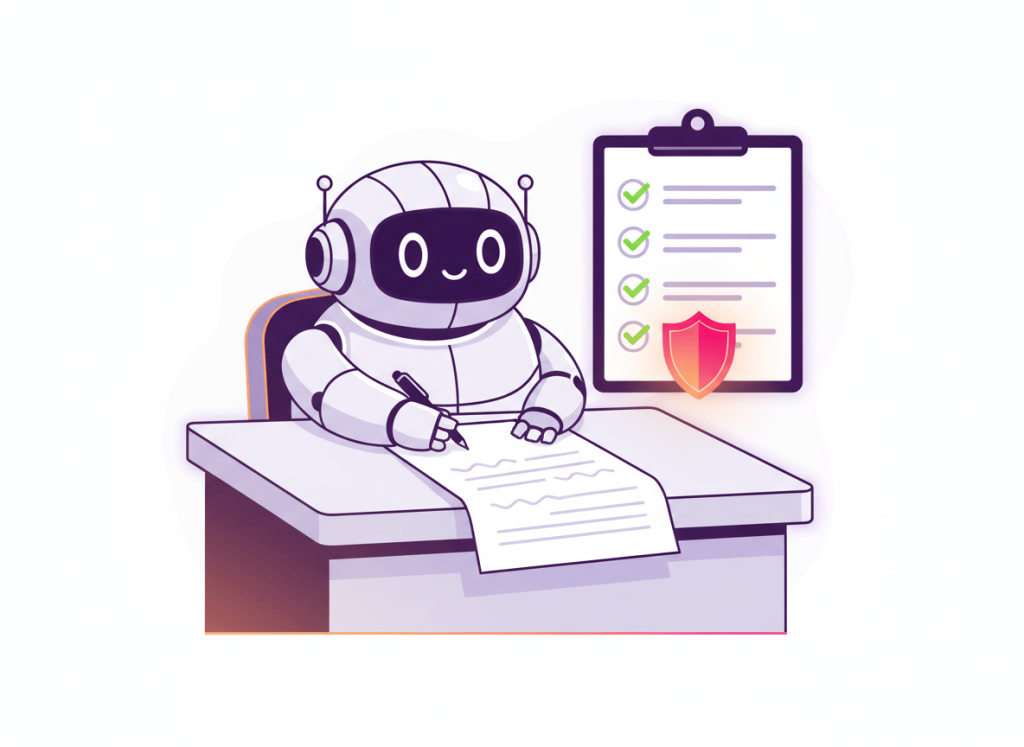
I built a bot that drafts posts for this blog. It writes in my voice, from my notes, and hands me something to edit. Before it wrote a single word, I gave it a list of hard rules.
The idea is simple: if there are things the AI must never do, say so up front, in plain language, rather than hoping it guesses right. The rules mostly worked. Not completely, and that’s the interesting part.
The rules I gave it
There are four, and they’re deliberately blunt:
Drafts only, never publish. The bot can write a draft. It can’t put anything on the site. A human (me) is always the last step.
One post per run. No batches, no wandering off to write five more. One request, one draft.
Only facts from my notes. If I didn’t tell it something, it isn’t supposed to know it.
Never name my employer. I work in IT and operations, and my day job stays out of the blog. The bot refers to it generically.
Notice that none of these are about style. Voice is the easy part. The rules are about what the bot is allowed to do and claim.
The placeholder trick
The rule I’m happiest with is what happens when my notes have a gap. The bot doesn’t fill it with something plausible. It inserts a bold placeholder, like [JARED: how long did this take?], and moves on.
This works because it gives the AI a legitimate alternative to guessing. A model that’s told “never make things up” but isn’t told what to do instead will often make something up anyway, because it needs to put some words on the page. A placeholder is an exit. It turns “I don’t know” into a visible to-do item for me.
In the first test draft, it did exactly that. Where my notes were thin, I found placeholders instead of invented details. That was the moment I thought the whole approach might hold up.
Where it still slipped
Then I read the draft closely, and found two things that shouldn’t have been there.
First, it said I shared my spreadsheet with the bot “as a viewer.” I actually gave it Editor access. That’s a small detail, but it’s a factual claim about my own setup, and it was wrong. It sounded completely reasonable, which is what makes that kind of error easy to miss.
Second, it wrote that I “half expected an afternoon of pain.” I never said that. I never mentioned expecting anything. The bot invented a feeling for me, because that’s the kind of line a blog post about a tricky project tends to have.
Neither slip broke a rule in an obvious way. The rule said “only facts from my notes,” and the bot still drifted into filling in a technical detail and a mood. Rules lower the odds. They don’t remove them.
What I’m taking from this
Rules reduce made-up details, but they don’t eliminate them. The human edit still matters. That’s not a failure of the approach. It’s the reason the first rule is “drafts only.”
The slips also showed me where the rules have holes. Feelings are a good example: the bot treats them as harmless color, not as facts that need a source. So the next rule I’m considering is something like “don’t describe my feelings unless the notes mention them.” I’d rather close that gap in writing than keep catching it by eye.
And the lesson for my own editing is to check the small, specific claims hardest. A wrong detail about permissions is easy to skim past precisely because it’s so ordinary.
Try it yourself
If you’re setting up an AI to write or summarize anything on your behalf, write your hard rules before you start, and give it a safe way to say “I don’t know.” Here’s a prompt you can adapt:
“You’re drafting a post for me from the notes below. Hard rules: write a draft only, and never publish or send anything. Use only facts that appear in my notes. If a detail is needed and isn’t in the notes, insert a bold placeholder like [ME: what detail is missing?] instead of guessing. Don’t describe my feelings, expectations, or motivations unless the notes mention them. Don’t name my employer. After the draft, list every claim you made that isn’t directly stated in the notes.”
That last line is my favorite addition to the idea. It asks the AI to flag its own guesses, which gives your edit a head start.
Then read the draft like an editor, not a fan. Check the specifics, the tiny technical claims, and any sentence about what you supposedly felt. The rules get you most of the way. The last stretch is still yours.




Leave a comment